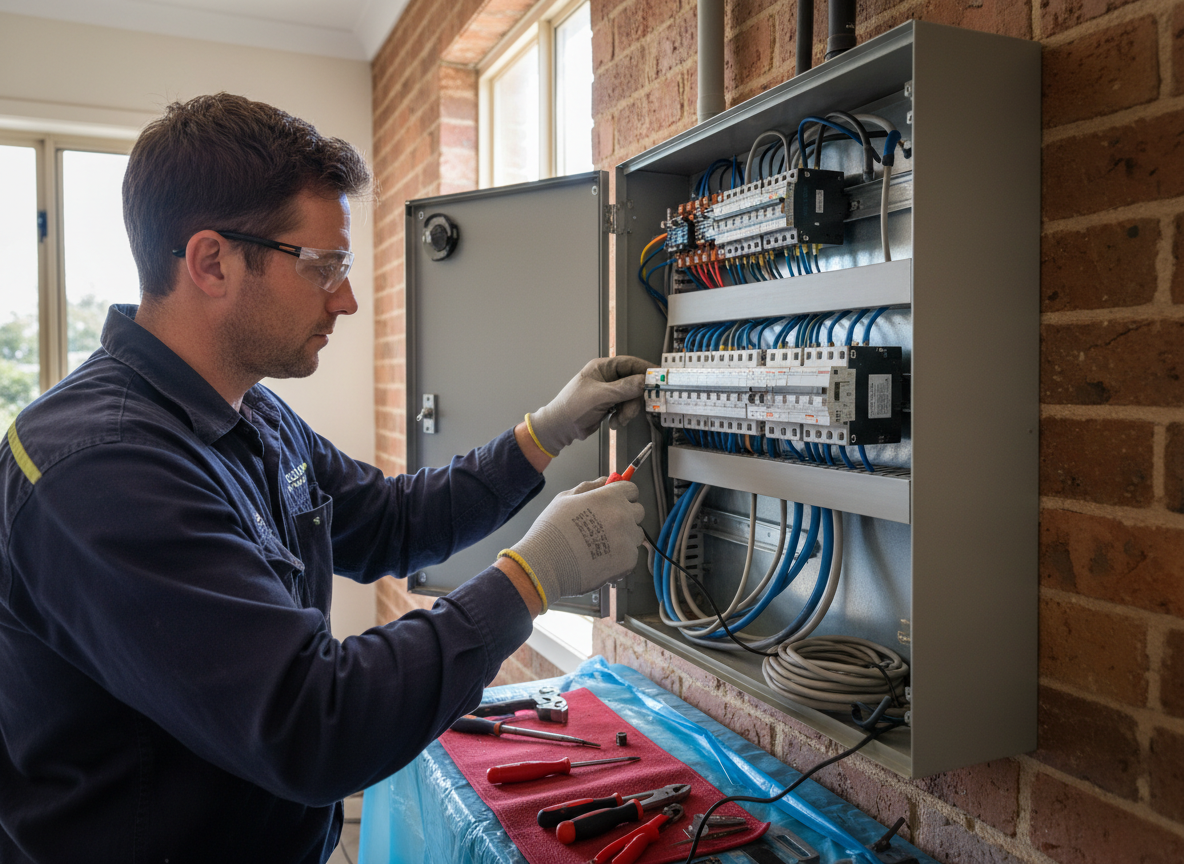
Understanding safety switch cover in a Sydney home
A safety switch (RCD) cuts the power almost instantly when current leaks to earth, for example through a person touching a faulty appliance. That fast cut lowers the risk of electric shock and electrical fire, so in a Sydney home it belongs on the power point and lighting circuits people use every day.
Spotting missing or partial safety switch cover
Open the board door but leave everything inside alone. Safety switches usually carry a small button marked T or Test. If you see none, or only one or two on a board with many circuits, some circuits are probably running without shock protection. Tenants, buyers and insurers often raise exactly this point.
RCD, MCB and RCBO explained
A circuit breaker (MCB) trips when a circuit draws too much current or shorts, which protects the wiring. An RCD watches for leakage to earth, which protects people. An RCBO does both jobs in one device for a single circuit, so a fault there switches off that circuit only.
Type A versus Type AC safety switches
Type AC devices detect ordinary alternating leakage current. Type A devices detect that plus pulsating direct leakage, which some appliances with electronic drives can produce, such as induction cooktops, inverter air conditioners and modern washing machines. Ask which type suits your appliances before comparing prices.
The decision to add one switch or upgrade the board
Adding safety switches to an existing board can work when the board is sound and has spare room. Where it still has old fuses, no space or tired wiring, upgrading the board is usually the cleaner path. Circuit testing on the day shows which option fits your home.
Why spreading the circuits matters
One shared RCD across many circuits means a single fault can black out half the house, fridge included. Several devices, or an RCBO on each circuit, keep a nuisance trip contained. Board wiring must be done by, or under the supervision of, a licensed electrician and certified with a CCEW that is given to you.
Your next step for safety switch protection
Note your suburb, count the test buttons on the board and list any circuits that trip often or seem to have no cover. Then decide whether you lean towards an RCBO per circuit or a few shared RCDs. Request a quote here for safety switch installation, and a licensed and insured local contractor can follow up.
Safety Switch Installation Services We Offer
✓RCBOs on Individual Circuits
An RCBO on each circuit, so a fault trips only that circuit and the rest of the home stays on.
✓Shared RCD Protection
Safety switches that each cover a group of circuits, with the circuits spread so one trip does not shut down most of the house.
✓Type a Safety Switches
Devices that also detect pulsating direct leakage, suited to circuits feeding appliances with electronic drives.
How it works
- 1
Check the current cover
Count the safety switches on the board and note which circuits they protect, without touching anything inside the board.
- 2
Inspect and test the board
The electrician checks the board's condition and space and tests each circuit to see whether adding devices works or an upgrade is needed.
- 3
Fit the safety switches
RCDs or RCBOs go in on the circuits that need them, using the type chosen for your appliances, with the power off while the work is done.
- 4
Test and certify
Every new device is tested, and a CCEW covering the work is lodged and handed to you for your records.